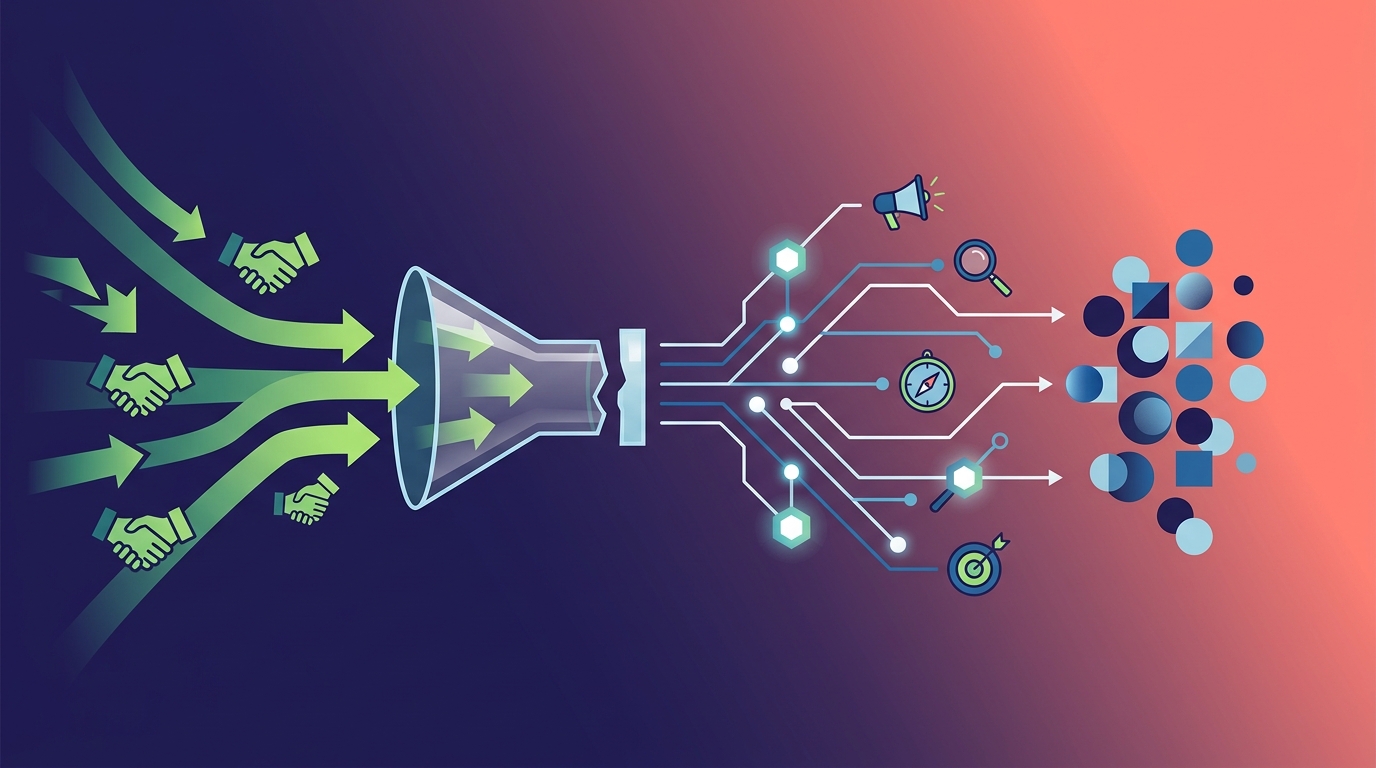
Direct answer: Marketing automation for a $1M–$3M accounting firm does its best work in three narrow places: routing an inbound inquiry to the right partner before it goes cold, running a nurture sequence for a prospect who isn't ready to switch accountants yet, and keeping a CRM clean enough that nobody loses track of where a lead actually came from. Gartner's latest CMO survey (n=402 CMOs, fielded August–October 2025) found marketing leaders expect AI-driven automation to cover 36% of marketing work by 2028, more than double the 16% it covers today — real, accelerating, and worth planning for. What automation does not do is replace the conversation that actually gets a partner hired. That conversation still runs on trust, and trust doesn't automate.
The Strategic Detail
- Lead routing is a speed problem, not a persuasion problem — automate it first. A downloaded tax-planning guide or a contact-form submission is a hot event with a short shelf life. The fix is routing and an internal response-time rule, not more content. This is the one place where Gartner's curve (16% today, 36% by 2028) matters most directly: firms that automate routing now are ahead of where the category is heading, not behind it.
- Nurture sequences earn their keep in the "not yet" segment, not the referral pipeline. A prospect who found the firm through a colleague's recommendation is already most of the way sold; a prospect who downloaded a resource six months before a real conversation is not. Automated nurture is built for the second group — it keeps the firm visible without a partner personally following up every few weeks, which doesn't scale past a handful of prospects.
- CRM hygiene is the quiet prerequisite, not an optional add-on. B2B contact data decays at roughly 2% a month. Automating a nurture sequence or a routing rule on top of a CRM nobody has cleaned in a year just automates the mistake faster.
- The gap is usually strategy, not tooling. Thomson Reuters' 2026 Future of Professionals Report (n=1,816 professionals across law, tax, audit and accounting, fielded March–April 2026) found 74% already use AI tools weekly, but 91% believe their own organization falls short of AI's real potential, and 35% say their AI ambitions aren't reflected in daily work. Most accounting firms already have an AI tool. Very few have decided, in writing, which three marketing tasks it's allowed to touch.
The Implementation Process
- Map the trigger events worth automating. Content downloads, contact-form submissions, webinar signups — pick two or three real events, not every possible one, and route each to a named partner with a response-time rule attached.
- Build one nurture sequence for the "not yet" segment before building a second. Keep it Human-in-the-Loop: AI drafts the sequence, a partner or strategist edits every send before it goes out. In a category where formality and discretion signal competence, a generically-phrased automated email costs more credibility than the automation saves in time.
- Fix the CRM before automating on top of it. Make referral source and lead source required fields, and audit them monthly — a routing rule built on missing data just routes the guesswork faster.
- Put the boundary in writing. Name what never automates: the discovery call, the fee conversation, the actual pitch. Nothing a partner needs to personally stand behind in a client relationship gets drafted or sent by a workflow alone.
- Revisit the scope quarterly, against the category's own pace. Gartner's curve moves from 16% to 36% over two years — that's the pace to plan against, not a vendor's roadmap. Add one automated workflow at a time, and only once the last one is actually working.
None of this requires an accounting firm to become a technology company. It requires deciding, in writing, which three or four tasks automation is allowed to touch, and holding the line on everything else. The firms that get this wrong tend to automate the parts that build trust and staff the parts that don't; the ones that get it right do the opposite — and free up a partner's time for the one conversation no workflow will ever run.